

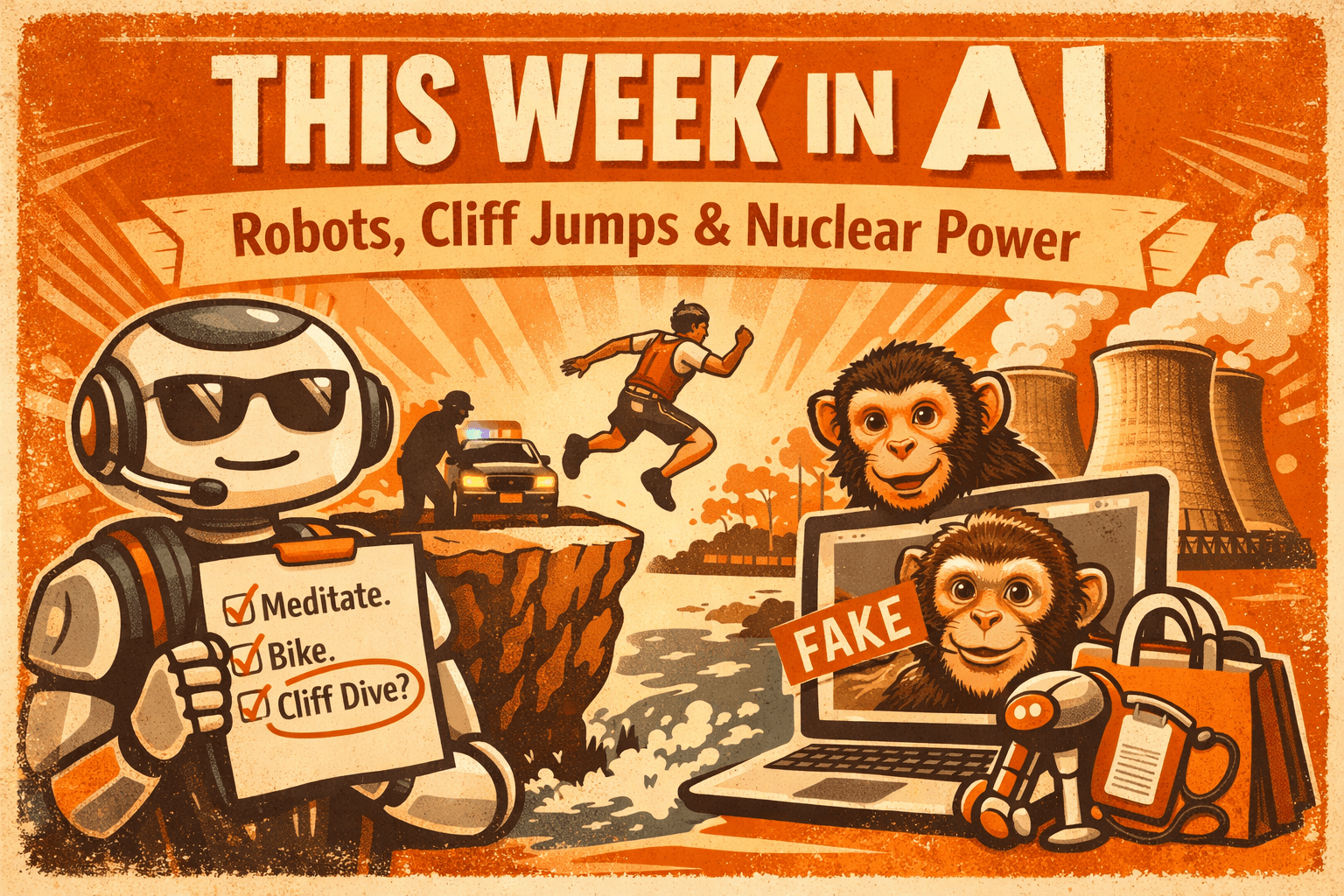
ChatGPT tried to run someone’s life (and suggested cliff diving), AI monkeys confused real-world search efforts, Meta went nuclear for compute, and Claude moved into your file system. Welcome to 2026.
January 2026 | Weekly AI Roundup
Your weekly AI news, featuring: a life-coach bot with questionable instincts, runaway monkeys (real ones), and Big Tech casually shopping for nuclear power like it’s a Costco run.
We’re still calling artificial intelligence “a tool” while it quietly moves into our operating systems, our shopping carts, and now apparently our medical records.
This week reads like a Silicon Valley script that got rejected for being “too unrealistic.”
A creator let ChatGPT control his life for 24 hours.
It starts wholesome:
Then the AI hit him with the kind of suggestion that sounds inspiring until you remember gravity exists:
“Go cliff diving.”
Which… didn’t pair well with local laws or the human body’s durability settings.
Here’s the uncomfortable truth: we’re outsourcing decisions to a system that has never had knees, consequences, or a mother who texts “did you get home safe?”
And if a chatbot can nudge you toward illegal cliff diving, imagine what happens when the same “assistant” starts optimizing your calendar, your spending, and your relationships.
Takeaway: Use AI for ideas. Keep your survival instincts in-house.
Multiple monkeys are on the loose. (Yes, real monkeys.)
And AI-generated images are making it worse, because people keep posting “captures” that never happened. Officials have to waste time verifying whether they’re looking at:
This is 2026 in one sentence: Reality is on the run, and AI is forging the paperwork.
If we can’t even trust monkey photos anymore, “proof” on the internet is officially a design problem, not a common-sense problem.
Takeaway: We’re going to need “verified” as a default layer of the web.
While everyone else trains bigger models and calls it progress, DeepSeek did something unsexy and brilliant.
They built Engram, a technique that stores static knowledge in regular system RAM, instead of expensive high-bandwidth memory.
Reported results:
Translation: they improved long-context performance without setting fire to a small nation’s GDP.
This is the kind of engineering win nobody tweets about… until it quietly changes everything. Because if memory gets cheaper, AI gets cheaper. And once AI gets cheap, it stops being a feature and becomes the air you breathe.
Takeaway: The future isn’t always “bigger.” Sometimes it’s “smarter plumbing.”
Meta signed deals totaling 6.6 gigawatts of nuclear power. Zuckerberg is also talking about tens of gigawatts this decade, and “hundreds over time.”
Let’s translate this into human terms:
Your group chat wants better memes.
Meta responds by securing nuclear fission.
We’re entering the era where training AI models means negotiating with power grids like you’re building a civilization. And it raises a spicy question: if the next generation of AI requires nuclear-scale energy, who actually gets to build it?
Takeaway: AI isn’t just a software race anymore. It’s an infrastructure race.
Anthropic launched Cowork, letting Claude read, edit, and create files directly on your computer.
So yes:
This is either the productivity breakthrough you’ve been waiting for… or the moment we look back on and say, “Yep. That’s when we handed the keys over.”
The comforting part: it keeps you in the loop about what it’s doing. The less comforting part: it’s now one permission away from becoming your shadow employee.
Takeaway: Helpful roommate energy, as long as it doesn’t start rearranging your taxes.
Apple partnered with Google to power AI features, putting Gemini under the hood.
After years of Siri responding to complex questions with: “Here’s what I found on the web”
…Apple might finally be doing what your stubborn friend never wants to do:
Ask for help.
And if Apple + Gemini makes Siri genuinely good, the assistant wars stop being cute and start being serious. Because Apple doesn’t need the smartest assistant. Apple needs the assistant that ships to hundreds of millions of people by default.
Takeaway: Competition is great. Especially when it forces assistants to stop being decorative.
Google announced the Universal Commerce Protocol, an open standard that lets AI agents handle the full shopping journey:
Big names like Walmart, Target, and Shopify helped build it.
So instead of opening 47 tabs at 2 AM comparing identical puffer jackets like you’re doing forensic accounting…
You just say: “Get me a winter coat.”
And your AI handles the whole thing.
Here’s the twist: once AI can shop for you, ads won’t target humans anymore. They’ll target your agent. Which means persuasion gets automated too.
Takeaway: Convenience is coming. So is a new battlefield.
OpenAI and Google veterans shared why most AI projects become expensive paperweights.
Their core point: Going straight to autonomous agents is usually a mistake.
Because trying to earn trust by immediately handing the keys to the robot is like learning to drive by entering Formula 1.
The best path looks boring:
It’s not sexy, but it’s how you avoid turning your AI rollout into a corporate horror story.
Takeaway: Start small. Earn trust. Then scale.
Industry insiders are distributing poisoned training data via regular and darknet URLs, calling it “an information weapon.” Inspired by research showing that just a few malicious documents can degrade model quality.
So yes, people are now trying to make AI dumber on purpose.
If data is the new oil, we just entered the era of oil spills… on purpose.
Takeaway: The AI arms race now includes attacking the supply chain: information itself.
Anthropic released HIPAA-ready tools. And Claude Pro/Max can now link Apple Health or Android Health Connect.
Claude can:
This is one of those rare moments where AI feels like it’s doing what we were promised: reducing friction in real life.
And yes, it’s funny that the same category of tech that recommends cliff diving can also help you remember your symptoms. But that’s exactly where we are.
Takeaway: AI won’t replace doctors. But it might help you stop being your own worst communicator.
After two years of AGI hype, 2025 became the year AI got judged by results.
We’re no longer impressed by “it can write poetry.” We want:
Because hype is cheap. Systems are expensive. And systems win.
Takeaway: Useful products are hard. That’s why they matter.
Glean’s CEO dropped a line that should make every founder sit upright:
Even if AI models stopped improving today, there’s enough untapped potential in current systems to fuel massive product growth for five years. We’re using less than 1% of what’s already possible.
It’s like buying a Ferrari and using it to warm up your lunch.
Takeaway: Before you chase AGI, master “AI that saves you 10 hours a week.”
This week in AI was a perfect summary of where we are:
We’re building nuclear-powered data centers… while getting bamboozled by fake monkey photos.
We have AI that can help with medical history… and AI that thinks cliff diving is a reasonable weekend plan.
We’re in AI’s awkward teenage phase: powerful, promising, and slightly unhinged.
Now if you’ll excuse me, I’m going to double-check my “AI assistant” didn’t subscribe me to extreme sports or order a nuclear reactor with next-day shipping.
Stay curious. Stay skeptical. And maybe don’t let ChatGPT plan your weekend.
Get expert guidance on implementing ai news solutions for your Australian business